别再搞混了!摩托车ADV和拉力,真不是一回事|Stop mixing them up! Motorcycle ADV and rally bikes are truly not the same thing.
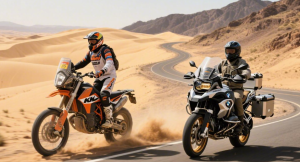
玩摩托的时间久了,总能听到有人把ADV和拉力摩托混为一谈,开口就是“我想买个拉力,预算10万,推荐个ADV”。其实这俩玩意儿,看着长得像、都能跑烂路,但核心定位、用法甚至骑起来的感觉,差得不是一星半点。
先给大家一个最直白的结论:所有拉力摩托,都能算ADV,但不是所有ADV,都能叫拉力摩托。简单说,ADV是个“大圈子”,拉力是这个圈子里“偏硬核、偏性能”的一小部分,就像SUV里有城市SUV和硬派越野,本质都是SUV,但用法天差地别。
很多人搞混,核心是因为它们长得太像——都是高离地间隙、长行程悬架、有护手、能装三箱,甚至很多厂家宣传时,也会故意模糊两者的界限,把自家的ADV叫做“拉力款”。但只要你真的骑过、用过,就会发现,两者的区别,藏在每一个细节里,也藏在你真正的骑行需求里。
先搞懂两个词:ADV和拉力,到底指什么?
先澄清一个误区,很多人以为“拉力”是“长途拉力赛”的简称,其实不全对。摩托车里的“拉力摩托”,确实和拉力赛有关,但更多是指“能适应高强度越野、能应对长距离复杂路况”的车型;而ADV,是英文Adventure(冒险)的缩写,直译就是“冒险摩托”,核心是“能兼顾公路和轻度越野,适合长途探险”。
举个最直观的例子:你平时在城市通勤,周末偶尔跑个郊区土路、 gravel路(碎石路),偶尔来一场上千公里的长途摩旅,选ADV就够了;但如果你想骑着摩托穿越无人区、翻山越岭,甚至去参加初级越野拉力赛,那必须选拉力摩托——前者是“全能家用款”,后者是“专业越野款”。
核心区别:4个维度,一眼分清ADV和拉力
不玩虚的,从骑士最关心的4个点,把区别讲透,没有专业术语,全是实在体验。
1. 定位和用途:一个“全能兼顾”,一个“极致越野”
ADV的核心定位,是“多场景适配”。它既要能在城市里灵活穿梭,又要能在国道、高速上跑长途舒服,还要能应对轻度的非铺装路面——比如乡村土路、轻度碎石路、浅坑洼。它的设计初衷,是让你“一辆车,能去更多地方”,不用为了不同路况换车。
比如本田Africa Twin(非双)、宝马GS系列(比如R 1250 GS)、春风800MT,这些都是典型的ADV。它们在公路上的表现很舒服,坐姿直立、风阻保护好,长途骑几百公里不累;偶尔下道跑点烂路,也能轻松应对,但你要是硬让它去爬陡坡、过深沟,就有点勉为其难了。
而拉力摩托,定位就是“越野优先”。它的设计一切围绕“能在最复杂的路况下走得通”,公路表现只是“附带功能”。比如KTM 450 Rally、胡斯瓦纳701 Enduro、雅马哈WR450F,这些车型,更适合专业玩家,或者真正想穿越无人区的骑士。
简单说:ADV是“公路+轻度越野”,拉力是“越野+轻度公路”;ADV适合“休闲探险”,拉力适合“硬核穿越”。
2. 车辆配置:细节里全是差异,一分钱一分货
配置是最能体现两者区别的地方,不是说ADV配置差,而是两者的配置侧重点完全不同。
先看ADV:配置更偏向“舒适和实用”。比如会配备大尺寸风挡、加热手把、座椅加热、大屏车机、蓝牙、定速巡航,甚至有些高端ADV还有电子悬挂、多种骑行模式(公路、雨天、轻度越野)。这些配置的目的,都是为了让长途摩旅更舒服、更便捷。悬架行程一般在150-200mm之间,足够应对轻度烂路;轮胎是“公路+越野”两用胎,公路抓地力好,轻度越野也能应付。
再看拉力摩托:配置更偏向“耐用和越野性能”。风挡很小(甚至没有),座椅很硬(追求支撑性,不考虑长时间舒适),基本没有多余的电子配置,车机也很简单,重点是“皮实耐造”。悬架行程更长,一般在250mm以上,能轻松应对深沟、陡坡、大起伏路面;轮胎是纯越野胎,胎纹深、抓地力强,能在泥泞、碎石路上站稳脚跟,但在公路上骑行时,噪音大、油耗高,舒适性很差。
还有一个关键区别:拉力摩托大多是“单缸”,排量不算特别大,但扭矩足、动力输出直接,适合越野时的低速攀爬;而ADV大多是“双缸”,排量更大,动力更平顺,适合长途高速骑行。
3. 骑行感受:一个“舒服好开”,一个“硬核难驾驭”
骑过两者的人,都会有一个直观感受:ADV好开,拉力难骑——尤其是对于新手来说,差距更明显。
ADV的坐姿很直立,坐垫宽大柔软,长时间骑行不容易累;方向盘转向轻盈,操控灵活,哪怕是新手,也能轻松驾驭,在城市里停车、变道,和普通摩托车差别不大。哪怕是跑烂路,悬架也能过滤大部分颠簸,骑起来很稳。
但拉力摩托就不一样了,它的坐姿更战斗,坐垫硬、行程短,长时间骑会很累;转向偏重,操控更精准,但也更考验技术——因为悬架行程长,高速骑行时会有轻微晃动,需要更好的控车能力。而且拉力摩托的重心更高,低速行驶时,很容易倒车,新手很难掌控。
举个例子:你骑着ADV,能轻松从城市开到郊区,再跑一段土路,全程很舒服;但你骑着拉力摩托,在城市里开半小时,就会觉得手酸、屁股疼,跑高速时噪音大,风阻也大,只有在烂路上,才能体现出它的优势。
4. 价格和后期成本:拉力更贵,养起来也更费钱
不管是买车还是养车,拉力摩托都比ADV更贵。
ADV的价格区间很广,从几万块的国产车型(比如春风450MT、贝纳利502X),到几十万的进口车型(比如宝马GS、本田非双),选择很多,适合不同预算的骑士。后期保养也比较省心,机油、滤芯的价格和普通摩托车差别不大,轮胎磨损也慢,因为大多时间在公路上行驶。
而拉力摩托,大多是进口车型,价格普遍在十几万甚至几十万,国产拉力车型很少,而且大多是偏向硬核的小众车型。后期保养也更费钱:越野胎磨损快,一套进口越野胎就要几千块;悬架需要经常检查、调试,费用也不低;而且因为经常跑烂路,车辆的损耗更快,维修频率也更高。
最后总结:怎么选?看你真正的需求,别跟风
很多人买ADV,其实是被“探险”“远方”的标签吸引,平时大多在城市通勤,偶尔跑个长途,根本用不上拉力摩托的硬核性能。这种情况下,选ADV就够了,兼顾舒适和实用性,不用为多余的越野性能买单。
如果你是真正的越野爱好者,经常去跑无人区、复杂越野路段,或者想参加拉力赛,那拉力摩托才是你的菜——它虽然难骑、不舒适,但能带你去ADV去不了的地方。
其实说白了,ADV和拉力的区别,本质就是“需求的区别”。没有好坏之分,只有适合不适合。不用觉得“拉力比ADV高级”,也不用跟风买拉力,毕竟对于大多数骑士来说,一辆能带你上下班、能陪你去远方、好开又舒服的ADV,才是最实用的选择。
以后再有人把ADV和拉力混为一谈,你就可以直接告诉他:能带你舒服跑长途、偶尔下道的,是ADV;能带你翻山越岭、硬刚烂路的,才是拉力。
本文仅四海天涯爱车网博主个人观点
After riding motorcycles for a long time, I often hear people mix up ADV and rally bikes, blurting out things like, "I want to buy a rally bike, budget 100,000 yuan, recommend an ADV." The truth is, these two might look similar—both can handle rough roads—but their core positioning, usage, and even the feel of riding them are worlds apart.
Let’s cut to the chase: All rally bikes can be considered ADVs, but not all ADVs can be called rally bikes. In simple terms, ADV is a "big category," and rally bikes are a small, more hardcore, performance-oriented subset within it. It’s like the difference between a city SUV and a hardcore off-roader—both are SUVs, but their purposes are completely different.
Many people confuse them because they look so similar: high ground clearance, long-travel suspension, handguards, the ability to mount panniers... Even manufacturers often blur the lines in their marketing, calling their ADVs "rally editions." But once you’ve actually ridden and used both, you’ll realize the differences lie in every detail and, more importantly, in your actual riding needs.
First, let’s clarify the terms: What do "ADV" and "Rally" actually mean?
There’s a common misconception that "rally" is short for "long-distance rally racing." In motorcycling, "rally bikes" are indeed related to rally sports, but more broadly, they refer to bikes built for high-intensity off-road use and capable of handling long distances over complex terrain. ADV, on the other hand, stands for "Adventure." The core idea is a bike that balances on-road comfort with light off-road capability, suited for long-distance exploration.
Here’s a straightforward example: If you commute in the city, occasionally ride on suburban dirt or gravel roads on weekends, and sometimes embark on thousand-kilometer tours, an ADV is enough. But if you want to ride through remote, trackless areas, cross mountains, or even enter amateur rally races, you must choose a rally bike. The former is the "versatile all-rounder"; the latter is the "professional off-road specialist."
Core Differences: 4 Key Dimensions to Tell Them Apart
Let’s get practical. Here are the four most rider-relevant points of difference, explained in plain terms based on real experience.
1. Purpose & Use Case: "Versatile All-Rounder" vs. "Extreme Off-Roader"
The core positioning of an ADV is "multi-scenario adaptability." It needs to be agile in city traffic, comfortable on highways and national roads for long distances, and capable of handling light non-paved surfaces—like rural dirt roads, light gravel, or shallow ruts. Its design philosophy is "one bike for many places," eliminating the need to switch bikes for different terrains.
Take the Honda Africa Twin, BMW GS series (e.g., R 1250 GS), or CFMoto 800MT—these are classic ADVs. They’re comfortable on paved roads, with an upright riding position and good wind protection, allowing you to ride hundreds of kilometers without fatigue. They can handle light off-road sections easily, but asking them to climb steep hills or navigate deep ruts is pushing their limits.
Rally bikes, however, are designed with "off-road performance as the priority." Everything is built around "getting through the most challenging terrain possible." On-road manners are just a bonus. Bikes like the KTM 450 Rally, Husqvarna 701 Enduro, or Yamaha WR450F suit professional riders or those truly planning to traverse wilderness areas.
In short: ADV = On-Road + Light Off-Road; Rally = Off-Road + Light On-Road. ADV is for "leisure adventure"; Rally is for "hardcore expedition."
2. Specifications & Features: The Devil’s in the Details. You Get What You Pay For.
Specs are where the difference is most apparent. It’s not that ADVs are poorly equipped, but their features focus on entirely different priorities.
ADVs lean toward comfort and practicality. Think large windscreens, heated grips, heated seats, large TFT displays, Bluetooth, cruise control. High-end ADVs may even have electronic suspension and multiple riding modes (Road, Rain, Light Off-road). The goal is to make long-distance touring more comfortable and convenient. Suspension travel typically ranges from 150-200mm, enough for light rough roads. Tires are 50/50 or 80/20 on/off-road compounds, offering good road grip while managing light off-road duties.
Rally bikes prioritize durability and off-road performance. They have tiny windscreens (or none), hard seats (for support, not long-distance comfort), minimal electronics, and simple instrument clusters—emphasis on being "tough and durable." Suspension travel is longer, often 250mm+, to easily handle deep ruts, steep climbs, and big bumps. Tires are full knobbies—deep tread, aggressive grip for mud, rocks, and loose surfaces. On pavement, they’re noisy, wear quickly, and offer poor comfort.
A key mechanical difference: Rally bikes are often single-cylinders. Displacement might not be huge, but they deliver strong, immediate torque perfect for low-speed crawling off-road. ADVs are often twin-cylinders (parallel-twins, V-twins)—larger displacement, smoother power delivery, better suited for long highway stints.
3. Riding Experience: "Comfortable & Manageable" vs. "Hardcore & Demanding"
Anyone who’s ridden both will tell you: ADVs are easy to ride; rally bikes are challenging—especially for beginners.
ADVs offer an upright riding position, wide, plush seats, and manageable weight, making long rides less tiring. Steering is usually light and manageable. Even a new rider can handle one easily; filtering through traffic or parking feels similar to a standard bike. On rough roads, the suspension soaks up most bumps, keeping things stable.
Rally bikes are different. The riding position is more aggressive, seats are hard and narrow, and they become fatiguing quickly. Steering is heavier and more precise, demanding more skill. The long-travel suspension can feel vague or wallowy at high speeds on pavement, requiring more active control. Their high center of gravity makes them prone to tipping over at low speeds or when stationary—a handful for novices.
Example: On an ADV, you can comfortably ride from the city to the countryside and tackle some dirt roads with ease. On a rally bike, you might feel arm pump and a sore back after just 30 minutes in the city. On the highway, wind blast and noise are significant. Its advantages only shine when the pavement ends.
4. Price & Running Costs: Rally bikes are Pricier to Buy and Own
Both the initial purchase and long-term ownership of a rally bike are generally more expensive.
ADVs span a wide price range, from tens of thousands for Chinese models (e.g., CFMoto 450MT, Benelli 502X) to hundreds of thousands for imported ones (e.g., BMW GS, Honda Africa Twin), fitting various budgets. Maintenance is relatively straightforward—oil and filter costs are comparable to standard bikes. Tires last longer since most riding is on pavement.
Rally bikes are mostly imported, often starting well over 100,000 yuan and going far higher. Domestic "rally" models are rare and tend to be niche, hardcore machines. Running costs are higher: Knobby tires wear out fast—a set of quality off-road tires can cost thousands. Suspension requires frequent inspection and servicing. The rigors of off-road riding lead to faster overall wear and more frequent repairs.
Final Advice: How to Choose? Follow Your Real Needs, Not the Hype.
Many people buy ADVs attracted by the "adventure" and "freedom" image but spend most of their time commuting, with the occasional long tour. They simply don’t need the hardcore capability of a rally bike. In that case, an ADV is perfect—offering a balance of comfort and practicality without paying for unused off-road prowess.
If you’re a genuine off-road enthusiast who frequently tackles technical trails, remote expeditions, or plans to compete, then a rally bike is your tool. It might be uncomfortable and demanding, but it will go places an ADV can’t.
Ultimately, the difference between ADV and rally boils down to a difference in need. There’s no "better" or "worse," only "right for you." Don’t think a rally bike is "superior" to an ADV, and don’t follow trends blindly. For most riders, a comfortable, manageable, and versatile ADV that handles commuting and the occasional adventure is the most practical choice.
Next time someone mixes up ADV and rally, you can tell them straight: What takes you comfortably on long trips with occasional detours is an ADV. What gets you over mountains and through brutal terrain is a Rally bike.
The above represents the personal views of the author from the website "四海天涯爱车网" (Four Seas, Horizon, Love Cars Network).
共有 0 条评论